

Power Wheelchair Comparison
Everything You Need to Know About Electric Wheelchairs! Power wheelchairs come in a wide range of types to accommodate all degrees of mobility. There are different accessibility features and multiple sizes, styles, and weight classes available. This page will go over everything you will need to know about electric wheelchairs to help you determine the right kind for you or your loved one.
Contact us for a FREE online evaluation
Different Types of Power Wheelchair s Drive System
There are three main kinds of drive system options for motorized wheelchairs. Power and maneuverability will be impacted by where these systems are placed. The drive wheels will also determine what terrain your powered wheelchair will be able to traverse. As a rule, casters (two small wheels) are located on the opposite end as the power drive, so the casters are located in the back for front-wheel-drive. For rear and mid-wheel drive, they are usually on the front.

Front-Wheeled
Front-wheeled chairs will be the best option for anyone who intends to spend a lot of time outdoors. Due to the drive motor being located in the front, it is easier for the wheels to pull up and over obstacles. In addition, there will also be a higher ground clearance for the front of the wheelchair, making it possible to roll over obstacles that might halt a mid-wheel drive system.

Full Size Scooter
These are best for people who mostly use their scooter outdoors. Full size scooter can accommodate bigger people and has bigger seat options with taller backs. The portable scooters generally have no seat options (except the Buzzaround HD offers a tall back now). The full size scooters have bigger batteries and can go longer distances. They do not make good indoor scooters though, they are just too big to turn around.
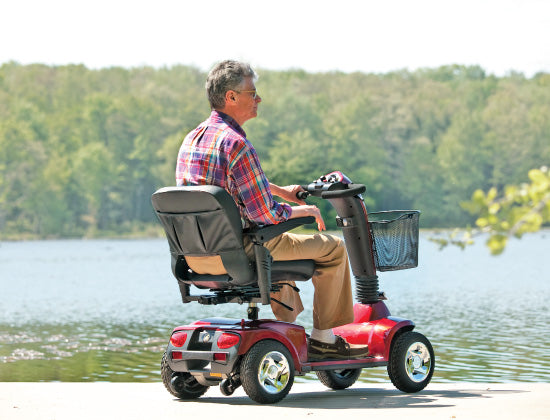
4-Wheeled Scooter
The 4-wheel scooter has a larger turn radius, but the added wheel gives more security when traveling over uneven terrain or inclines. They are ideal for outdoor strolls on mostly even ground. They can handle grass and gravel usually, but so can their 3-wheel counterparts. The main difference maker here is that they are more stable with a wider turning radius. There is one 4-wheel model, the Go-Go Zero Turn 4-wheel scooter, that has the stability of having 4 wheels, but turns like a 3 wheel.

3-Wheel Scooter
The 3-wheel scooter is a great option for the primarily indoor user because it has a tighter turn radius making it easier to avoid obstacles and move through doorways and around corners. The difference in stability from a 4 wheel is slight, although if someone is predominantly using scooter outside 4-wheel is better, but for the indoor user the trade-off in improved maneuverability is worth it.
Electric Wheelchair Size and Weight
The size and weight of the device will determine how easy it can be to use on travels. There are several main categories, and they each have their pros and cons. Lifestyle and physical needs will dictate, which is the best fit.

Travel Wheelchairs
For individuals who travel a lot for business or leisure, a travel wheelchair like the Pride Mobility Jazzy Passport is the way to go. It has a battery pack that is compliant with transportation codes so it can travel on a plane or bus. These are also lightweight (around 60 pounds), so they can easily fold up and move in and out of storage areas.
- Tight 25.25" turn radius
- Ability to travel up to 9 miles
- Maximum speed of 10 miles per hour
- 250-pound weight capacity

Folding Powered Wheelchairs
There is an overlap between the travel and folding electric wheelchairs since portable models are designed to be easy to move in and out of travel storage. The main difference between those and folding powered wheelchairs are the weight and degree to which they can be compressed. Folding wheelchairs can be under 60 pounds in weight and easily fit in very small spaces like a car's trunk.

Full-Size
A full-sized powered wheelchair can function perfectly fine indoor or outdoor. One example of the products for this category is the Pride Jazzy Elite 14, which has a front-wheel design for easier maneuverability. The drive system position also gives greater traction, so it is capable of handling various terrains.

Heavy Duty
Heavy-duty wheelchairs like the Jazzy 1450 are built out of sturdy materials and are designed to withstand more significant strain to the body and frame. It can move freely over various terrains and is fully capable of being driven off-road on grass, rocks, gravel, or dirt. The seat width can range from 20" to over 32", making it comfortable for any size.
- A ground clearance of 3"
- Incline rating of 6 degrees
- A maximum speed of approximately 4.5 miles per hour
- 600-pound weight capacity
How Terrain Affects Usage
Which wheels are attached to the drive system and how many batteries are included in the pack affect how well an electric wheelchair will function on various terrains and inclines. Other factors include the weight and size of the device and where the casters are located. Before choosing a powered wheelchair, it can be useful to make a list of the known locations around your home or work that may be an issue for some models so that you can ensure the one you end up purchasing fits your needs.
Indoors
Some things to consider about indoor spaces include how tight corners are, how much space is available on either side of doorways, and how wide the walkway is for halls and bedrooms. For individuals who will spend the majority of their time indoors, it will be important to be able to turn the front of the wheelchair a tight 90 degrees to move around obstacles.
Mid-wheel and front-wheel drive configurations can provide this level of control. Portable, folding, and full-sized electric wheelchairs are generally small enough to fit through most walkways. Heavy-duty devices may have a more challenging time, depending on the seat and frame width.
Outdoors
Inclines, ground terrain, and lack of proper accessibility in public areas (e.g., sidewalks, parking lots, malls, etc.) can be determining factors in choosing a model and type of wheelchair. Front-wheel and mid-wheel chairs in the heavy-duty and travel categories have the best control, stability, and power over outdoor terrains.
Main Features of a Power Wheelchair
One of the great things about powered wheelchairs is their ability to be customized in almost any way. Whatever specific needs a person may have in terms of mobility or comfort, there is either a current model that fits the bill or a company that can work with the individual to create the necessary adjustments. The following sections cover basic features that can be found in most electric wheelchairs
-
Different Seating Positions
Comfort and security are both essential to consider when looking for the right powered wheelchair. Seating positions can impact physical health if support is not provided in the right way. Pressure sores may develop along with aches and pains when a position is not supportive enough. Also, seating positions will need to be altered based on what someone is trying to accomplish. For example, reclining the chair so that the legs rest above the hips can help stop the buildup of pressure on the lower body.
-
Cushion and Seat
There are several ways in which seats and cushions can be customized to fit specific needs. For example, most heavy-duty powered wheelchairs can have the seat adjusted to be whatever size is needed to fit the individual. Also, ensuring proper cushioning will support good posture and help alleviate stress on the body.
-
Controlling Options
Which control option is best will depend on the degree of mobility users have while in their wheelchair. Most can be configured to the individual. We will go over the features for some of the most popular options below.
Joystick: Can come in standard or mini size, Controlled through either pressure or degree of deflection
Touchscreen: The touchpad works like a mousepad to control direction and speed of movement, No pressure control required, only hand or finger movement
Sip and puff: Sipping and puffing air through a tube (by inhaling and exhaling) allow for complete control of wheelchair speed, direction, and features like actuators or lights, The machine is capable of discerning the strength of the sip or puff to translate into a command, The programming is tailored to the individual
Head control: Controlled by switches located on the sides of the headrest, Pressing a switch starts a particular motion, and releasing it stops that motion. There is less fine control built into the design, Some switches are proximity-based while others require manual pressure, There can be quite a few switches giving even more control for features and movement
Foot control-pedals and buttons on the footrest: Hands-free control, All motions and features are controlled by the feet
Chin control: Joystick operated by the chin
Speech control-controlled by simple vocal commands: Capable of finer control settings, Programmable to fit the needs of the user -
Armrest Height
The armrests are designed to support the occupant’s arms with minimal stress. However, if they are too low, you may have to lean on one side for support, and if they are too high, your shoulders will hunch. Adding a cushion to the seat can help solve problems associated with overly high armrests.
The armrest height should be least of your worries when buying a wheelchair with adjustable armrests -
Backrest Height
The ideal wheelchair backrest height is the length between the seat and the user’s collarbone when sitting straight on the chair.
Most wheelchairs have a fixed backrest height, with their level of cushioning varying with the price. You can, however, extend backrest height with optional accessories to get more support. Chairs with adjustable backrests are also available but at a higher cost.
Electric Wheelchair Battery
Powered wheelchairs have sealed lead-acid batteries, which provide the power needed to run the drive system and other features. It often under the seat or in a box at the back of the device. The battery pack of the wheelchair can come in several power types. An average wheelchair will have 2-12 volt, 12 amp batteries. Larger chairs or those designed to work over outdoor terrains will usually have a bigger battery with higher amp output (2-12 volt, 75 amp batteries).
Public Transportation
There are laws about what types of wheelchair batteries are allowed on public transportation. They must be leak-proof and be certified by the FAA or other relevant agencies as safe for travel on vehicles like buses and planes. It is best to check with specific transportation services before using them to ensure they do not have any unusual policies regarding powered mobility devices.
Where is the Battery Located
Where you will find the battery is usually determined by which wheels are connected to the drive system. Front-wheel and mid-wheel chairs will usually have the power supply under the seat, while rear-wheel models have batteries located on the back of the device. There are exceptions, so this is not always the case. Sometimes the battery box is moved to balance out the weight.
F.A.Q - Frequently Asked Questions
-
How long does a power wheelchair last?
If maintained and treated correctly, an electric wheelchair can easily last five years or longer before needing to be replaced. The lifespan is going to be primarily determined by how much wear and tear it accumulates over that time.
-
Can power wheelchairs get wet?
The chair frame is mostly made of metal, and the controls are designed from delicate electronics. Water or dampness can cause significant problems to both through rusting and corrosion. Whenever possible, it is best to avoid both standing water and rain or runoff, but the chair should be thoroughly dried to prevent damage if avoidance is impossible.
-
Can an electric wheelchair be pushed?
Your powered wheelchair's motors will have a freewheel lever, which will allow you to propel the chair manually. Depending on the chair model, assistance might be required when engaging and disengaging them.
-
Can you overcharge a wheelchair battery?
This varies based on the chair. Some models boast an inability to overcharge. The best way to determine how to use the battery is to read through the instruction manual. There it will say whether the battery can be overcharged or not.
-
Can a mobility scooter fit in a car?
Compact models can fit in your vehicle. While travel scooters are specifically designed for this and are better at fitting into small spaces like a car trunk, other types of mobility scooters may also come with folding features that will allow them to fit into a car.
-
How long do power wheelchair batteries last?
Per charge, they last an average of eight hours or ten miles, depending on terrain and other factors. The overall lifespan of a powered wheelchair battery will be between six and eighteen months. After that, it will need to be replaced. Following manufacturer guidelines and maintaining your chair will help prolong the battery life.
